

Zendesk on Zendesk: Bump Bump Solve | Community
Skip to main content

Zendesk on Zendesk: Bump Bump Solve

  • May 14, 2015
  • 90 replies
  • 0 views

Matt69

Zendesk on Zendesk is a day-long discussion about a specific topic and how Zendesk Support uses Zendesk. Each session is hosted by a member of our Support team.

This session is about business rules we use at Zendesk to gently remind customers about tickets, and automatically close them if the customer is ready. It's something we like to call Bump Bump Solve. This session covers:

  • Overview of Bump Bump Solve and how it works
  • Configuration of Bump Bump Solve so you can set it up too
  • Benefits and modifications of Bump Bump Solve over time

This session is hosted by Matt M, who is a member of our Support Ops team in Melbourne.

See all of the Zendesk on Zendesk series discussions.

Part 1: Overview

At Zendesk we are always trying to think of new ways that we can make life easier for our Support Team.

Like many other support teams we love to use Zendesk, (it would be wrong if we didn’t right?) so our workflow revolves around the following ticket status':

  • New - untouched tickets that customers are waiting for an answer on
  • Open - tickets that the customer and and advocate are actively communicating
  • Pending - where the advocate is waiting for the customers response back.
  • Solved - yay!

Sounds familiar I’m sure. And it works really well. Though we wanted something even better, something that would make our Advocates lives even easier.

Over the course of an advocate’s day, there would usually end up being around 15-20 pending tickets in an agent’s workload. If a customer does not respond after a few days the advocates would manually have to go back and prompt the customer for an answer--usually more than once. We felt this was holding the advocate back, and taking up time that could be spent with new inquiries. This generated a discussion whereby we felt that agents would start their day by going back through all the pending tickets to update them in an effort to get something back from the customer as to whether it could be solved or they needed assistance.

Naturally we turned to Zendesk for answers, and an idea was born. What if we could take all the advocates pending tickets and auto prompt the customer after a certain amount of days? What if we could actually solve those tickets if we didn’t get a response back from the customer?

Enter Bump Bump Solve.

A series of automations and triggers designed to help advocates move forward. The idea was simple:
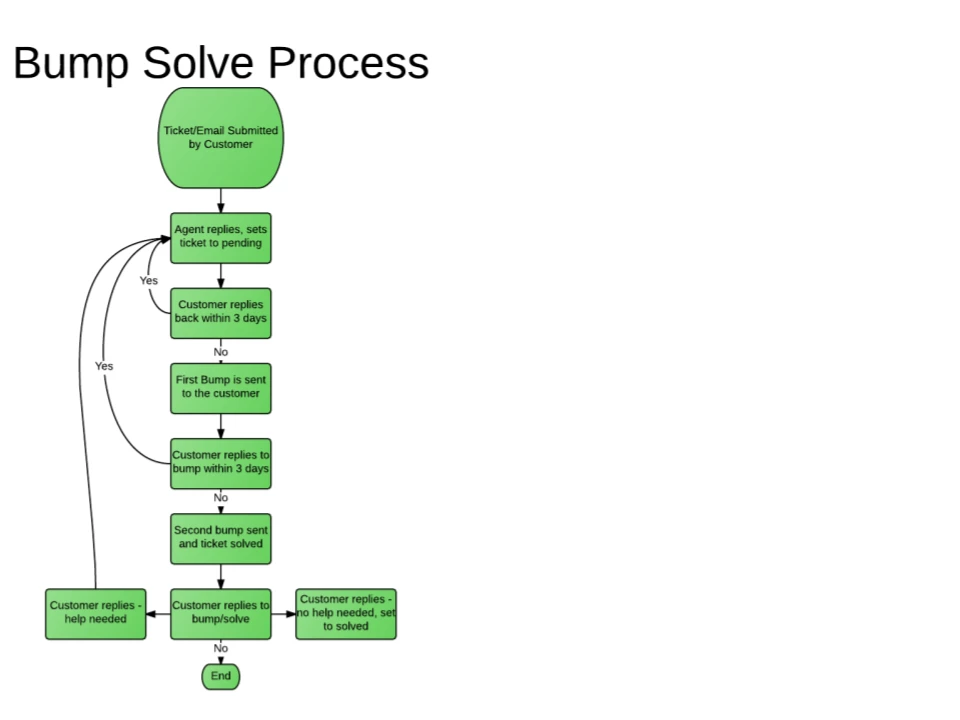
Part 2: Configuration

While the process sounds quite simple in theory, there is little more to it on the back-end. Let’s take a look first at the automations, then we’ll look at the triggers.

Setting up the automations

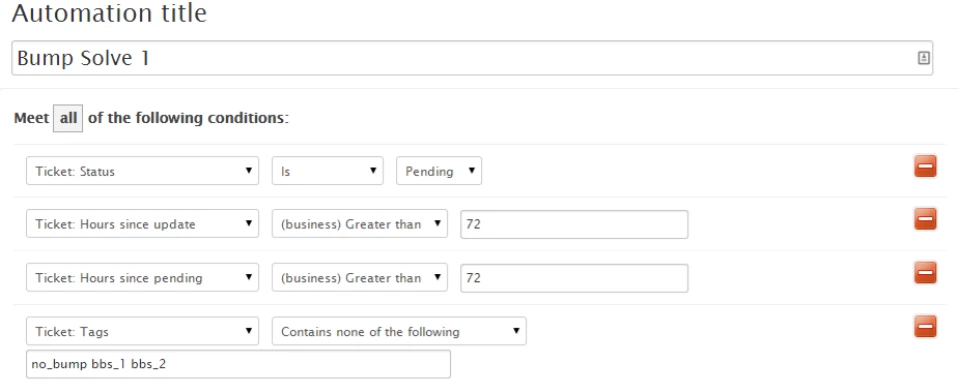
They do the heavy lifting, and are the rules that send the notification to the customer. (Note that using the tag no_bump can be used to exclude particular tickets from being bump-bump-solved.)

Depending on your Zendesk configuration and business needs, you can change the times and also change the conditions to reflect calendar hours instead of business hours.

Conditions for our first Bump Bump Solve automation:
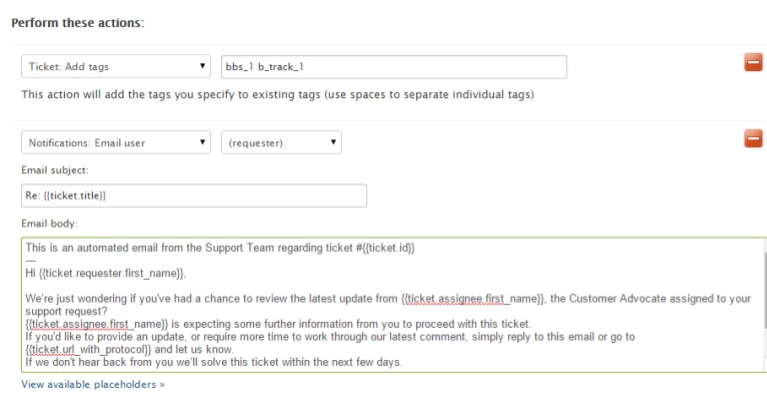
Actions for our first Bump Bump Solve automation:
 

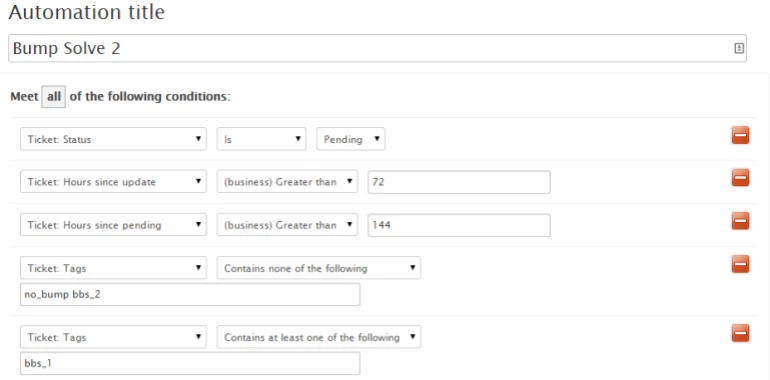
The conditions are slightly similar on our second automation, as we need to take into consideration the amount of time that has passed, and also allow for the time which the last bump happened - as this counts as a ticket update.

Conditions for our second Bump Bump Solve automation:
 

And our actions will also be a little different from the first automation.

Actions for our second Bump Bump Solve automation:
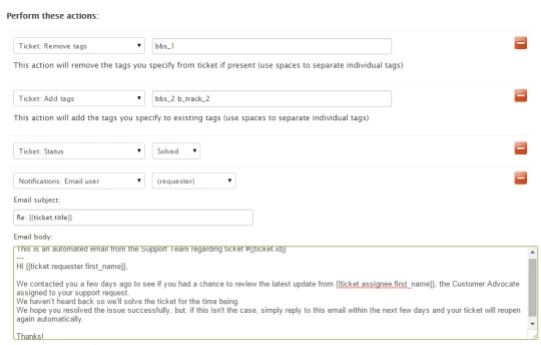
 

As you can see there are various tags being used, which will make a bit more sense when we go through the triggers. (Also, note that we used to actually bump the customer twice so the tags are bbs_1 etc. Now we've moved to just one bump, but it would be a bit weird if we used “bs” since... you know…)

This is also a fairly flexible automation, and if you have different groups that you want to add or exclude, you can do so in the ANY conditions part of the automation.

Setting up the triggers

Let’s take some time now to go through triggers, which act as the engine - watching, controlling, every time a ticket is updated.

Remove BBS tags upon reassign:
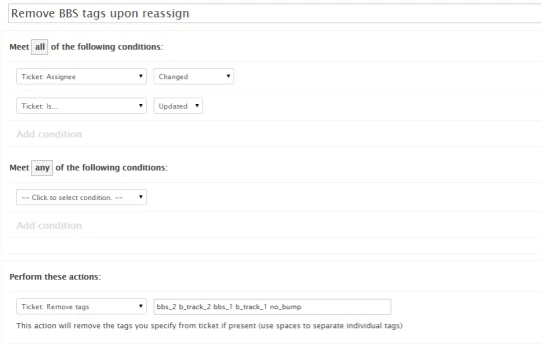
 

This will ensure that if the ticket is transferred to another employee that the Bump Bump Solve process will restart when it gets to that agent. The idea of reassigning the ticket would suggest that some work needs to be done by someone else.

Removing tags for open tickets:
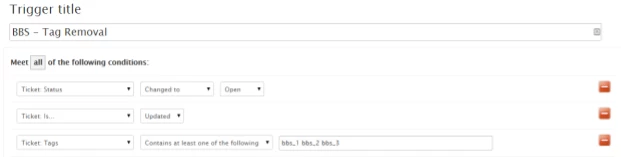
 

This trigger takes into consideration the customer replying. If the customer replies (depending on your business rules) it will set the ticket back to open. If this happens, we certainly don’t want Bump Bump Solve to carry on, so we remove all the tags again and wait for it to go back to pending, where the automation will start the process again.

You also want to add the same actions with a different set of settings to allow for closed tickets reopening as new tickets, as they will inherit the tags from the closed ticket.

Removing tags for closed tickets:
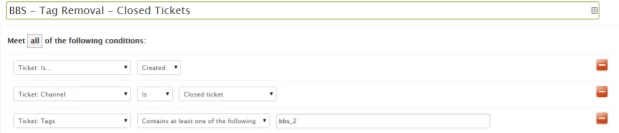
 

That’s really the bulk of the setup. From the screenshots, you can also see a couple of b_track tags which are used for internal reporting. Things like this are completely optional, and you can make any additions that you need. It really just shows how a basic setup would look.

Part 3: Solved :)

Originally we actually ran with Bump Bump Solve, so we would bump the customer twice, and then the third time would be the solved message. This would take about 9 business days, before the ticket was solved. With the weekends in there as well, it would be around the 2 week period before it was solved.

We decided to remove one of the bumps, and thus reduce the amount of time the ticket was sitting in a pending state. Remember though, if you use calendar hours, your bumps will be inclusive of weekends.

We like to think of Bump Solve as a win-win. It makes the advocates lives and days easier, and also, we don’t have to constantly hassle the customer (or solve their ticket too early).

To give a small insight into some numbers, for Q1 this year we had over 8000 tickets that were solved by Bump Solve alone. This represents around 15-20% of ticket volumes over the course of a normal working day.

By implementing this kind of workflow, we are able to keep our advocates focused on their new and open tickets. For tickets that don’t get updated, it’s no longer a matter of going through a manual process. The advocates can confidently work forward, knowing that their pending tickets will take care of themselves. We found it saves the advocate a small but considerable amount of time.

Do you think this would be something that would save your team time? Let us know in the comments below.

90 replies

ZZ55
  • May 26, 2015

Matt

That is an excellent article.

Setting the correct ticket status is an area that I see agents do very poorly. For example, I see comments like, 'Here is an update, I'll get back to you tomorrow'- status pending.

I would recommend that supervisors review pending tickets from time to time to ensure that they are truly pending so that they do not drop off the agent's radar or corrupt SLAs.


  • May 26, 2015

We have something like this already in place. Another trick that helps to ensure that reps don't mistakenly set the wrong status is to have macros set the status for them.


  • May 26, 2015

this is awesome...


i have a Diane-o-mation version of this using two macros.  Basically, my first macro is "have you resolved your issue, I see you haven't responded", and then a "couple days" later as i'm reviewing my pending YET AGAIN, i have a second macro for "i see you haven't responded, so we're closing this ticket, but if you need help, simply respond and we'll continue our conversation"...or something like that.

I've been meaning to make this into an automated process but didn't have the brain power assembled until my summer down-time season.

(Diane wants MORE MORE MORE of these kinds of things!!!)


  • May 26, 2015

Graeme, Kraven, and Diane,

Thanks for your input and recommendations! 

Matthew should be online soon to respond to comments as well. :)


Matt69
  • Author
  • May 27, 2015

@Graeme, agree! We run Insights reports on Pending tickets to make sure they don't blow out, but the majority are taken care of by the bump solve process.

@Kraven, this helps also push the ticket to work with this kind of process rather than relying on an agent to do it manually.

@Diane, some of our advocates had this setup as well, we thought it would be great to just have everyone do it, then automate it :)


  • May 27, 2015

Great stuff! We also do a bump-bump-solve here :)


  • May 27, 2015

Has this negatively impacted your SATISFACTION rate any?  When the client is offered the opportunity to rate the service are you getting any negative ratings due to the automated solve or is the satisfaction offering suppressed?


  • May 27, 2015

@Jeremy, as an e-commerce site with a relatively high volume of customer contacts through ZD, we've found that this process has not negatively impacted our NPS scores since we implemented this over a year ago. Wording is key of course.

The timeline we utilize is as follows. An automation sends a reminder after 48 hours for Pending tickets, and Solves at 72 hours. Solved tickets send an automated survey (with a SurveyMonkey link) at 5 days, and Closes the ticket at 7 days after Solve.


Nicholas47

We use a similar setup where we bump the customer 2x and then solve the ticket, all with automations.  Works out great.  To Jeremy's question, every now and again we get back a negative rating.  It's rare though and is just as common as it was with a manual process.


  • May 27, 2015

Thanks @Kraven @Nicholas - now I just need to teach my agents not to use it as a burial ground for unwanted tickets that they are avoiding responding to  

:- )


  • May 27, 2015

Jeremy, this has impacted our satisfaction a bit, yes. We solved it by setting two different automations for Satisfaction requests.

For regular solves, we send the regular stuff. "Hey, did you like it? We'd love to know!" or something.

For bump solves, we send something around "Hi! Your ticket was automatically set to solved because we didn't hear from you. Not satisfied? Please reply to this email and we'll keep talking until you're happy!"

Of course there are always those unhappy people who just tap "I hate you" and forget to read it, but this has reduced the practice almost completely. I feel that most people don't know exactly what to do and feel left out so that's why we came up with this.


Joe20
  • May 28, 2015

We're a little new to zendesk so this is exactly the type of thing we're excited about.

The one thing I'm not sure works so well is the lack of "Ticket: Comment" as an action in the automation or otherwise. I would much prefer to comment within the actual ticket rather than sending a new email, which would result in a new ticket if the customer replies. I think most of our customers would simply reply to the email rather than clicking on the ticket link, even if we asked them to.

We'd then need to make sure we're looking out for this and merge the tickets, which seems like a hassle. Would this be the case, or am I understanding the process wrong?


Matt69
  • Author
  • May 28, 2015

@Joe, for the automation, you can use the Notifications: Email user option, and it will automatically select "requester" in the adjacent field that will appear. 

This would count as an update to the existing ticket, so that if the end user replies, it will just add on the reply to the existing ticket as well.


I love this implementation, so thank you for sharing this with us, Matt.

I am very interested to know how you handle out-of-office responses with these automations. I know they end up in 'Suspended Tickets', but if you are aware a customer is out of the office for longer than the automation kicks in, how do you deal with this - do you add the tag to prevent the automation from taking place and remove it when they are back?


  • May 28, 2015

@Joe If they reply to that email it will update the same ticket so don't worry about it! The same happens for Satisfaction rating request emails.

@Jonathan I don't think Zendesk has any kind of auto-processing for suspended tickets, but nevertheless the customer can always reply back and reopen the ticket when s/he gets back. 


  • June 1, 2015

I don't have the ticket status Hours Since Pending or Hours Since Update. Do I need to update or is this my plan?


  • June 1, 2015

To all,

Great stuff!

I set my Triggers and Automations (similar process to the above) about 10 months ago due to the large amount of pending tickets we had at level 1 Support. Since introduced, it's certainly speeded things up. Works 100%.

*My only addition was some extra views for level 1 support.


Example: When the agent applies a macro (e.g 'B') the ticket goes into the holding pen (A) until 72hrs comes around... (escalates to 'C') and so on. The final macro (D) notifies the end-user that the ticket will considered closed within 24 hours. This is done automatically.


(A) All CSC Pending tickets                               21

(B) Pending tickets - Over 2 days (48hrs)       7

(C) Pending tickets - Over 3 days (72hrs)      10

(D) Pending tickets - Over 5 days (120hrs)      4


To manage pending tickets, our agents only refer to views B, C, and D.

Hope this helps?


Pierre


  • June 2, 2015

I have been trying to do something like this for quite some time. I followed all the steps listed above yet after the specified amount of hours the tags get removed but an email message is not sent to the client. Any suggestions?


  • June 2, 2015

Hi Andrew! 

The notification should be going out as part of the automation that adds the tags...can you tell me the names of your automations so I can hop into your account and take a peek?


  • June 9, 2015

Notifications seem to be going out based on the automations I mirrored from this article. Analysts have mentioned that they have gotten responses from customers referencing a "bump bump" email but there is no copy of the email logged in the ticket? Is there a step that maybe I missed that would add this to the ticket notes?


  • June 9, 2015

@Chris yes, there is a copy! You can click on "View all events" to track all triggers and automations that worked on a ticket, and from there you can see all notifications the users received. You can find the email under the automation that popped it.


  • June 11, 2015

I'm just about to implement this on our account, but we have a few custom fields that we require to be filled in before a ticket can be solved but not before pending. Would the automation still set the tickets to solved without those fields?

If not, any suggestions for the best way to handle this?

I'm thinking that if the fields weren't filled out it could reopen but keep the bbs etc tags so that the agent can make the selection from the fields and then solve the ticket without interrupting the flow too much.


  • June 11, 2015

Matthew, the answer is yes, setting a field with business rules will ignore dependencies except for permissions. So the ticket will be marked as solved. 

What I do is to run another rule ahead of this one that will invalidate the conditions of the solving rule if my dependencies are not met. For example i have an automation that sets the ticket as solved after being pending for x days. I have two variations of this automation, one that tests for a field being blank and the other does not have this test. In the first I do not set the status to solved but instead send an email to the agent. 


We have additional automations set up (such as if ticket has been going on for X days, notify manager) that are interfering with the 'Bump Bump Solve' automation as Zendesk seems to classify other automations as an update to the ticket.

What would be a suitable workaround? Am I right in thinking that "Ticket: Hours since update" includes automations?


ZZ55
  • June 16, 2015

Jonathan J

You also have under the ALL Conditions, 'hours since requester update' and 'hours since assignee update'. You may be able to use these as conditions to identify how long before a human has touched a ticket.